Enzymes in the Food Industry, Someone Is Working for Us
by Liran Gruda
If there is one field that quietly operates under the radar yet completely transforms the way we approach food product development, it is the world of enzymes.
This is not just another ingredient – it is a powerful technological tool that allows us to control processes at the molecular level: modifying texture, breaking down components, enhancing flavor, and even extending shelf life.
As a chef who transitioned into product development, I can say honestly, the moment you understand how to work with enzymes, the entire game changes. Suddenly, problems that seemed impossible to solve become manageable.
At Gruda, enzymes are an integral part of food product development processes especially when dealing with complex products, functional beverages, advanced bakery applications, and solutions for improving texture and flavor.
What Are Enzymes and Why Are They Important in Food Product Development?
Enzymes are proteins that act as biological catalysts meaning they accelerate chemical reactions in a highly specific manner.
But in the food industry, their significance goes far beyond that: they allowus to “design” the product from within.
Instead of adding more stabilizers, flavorings, or sugar, we can use enzymes to directly modify the system:
- Breaking down starches into sugars
- Modifying protein structures
- Breaking down fats to create flavor compounds
- Improving bioavailability of nutrients
This is the difference between treating a system externally and truly engineering its internal structure.
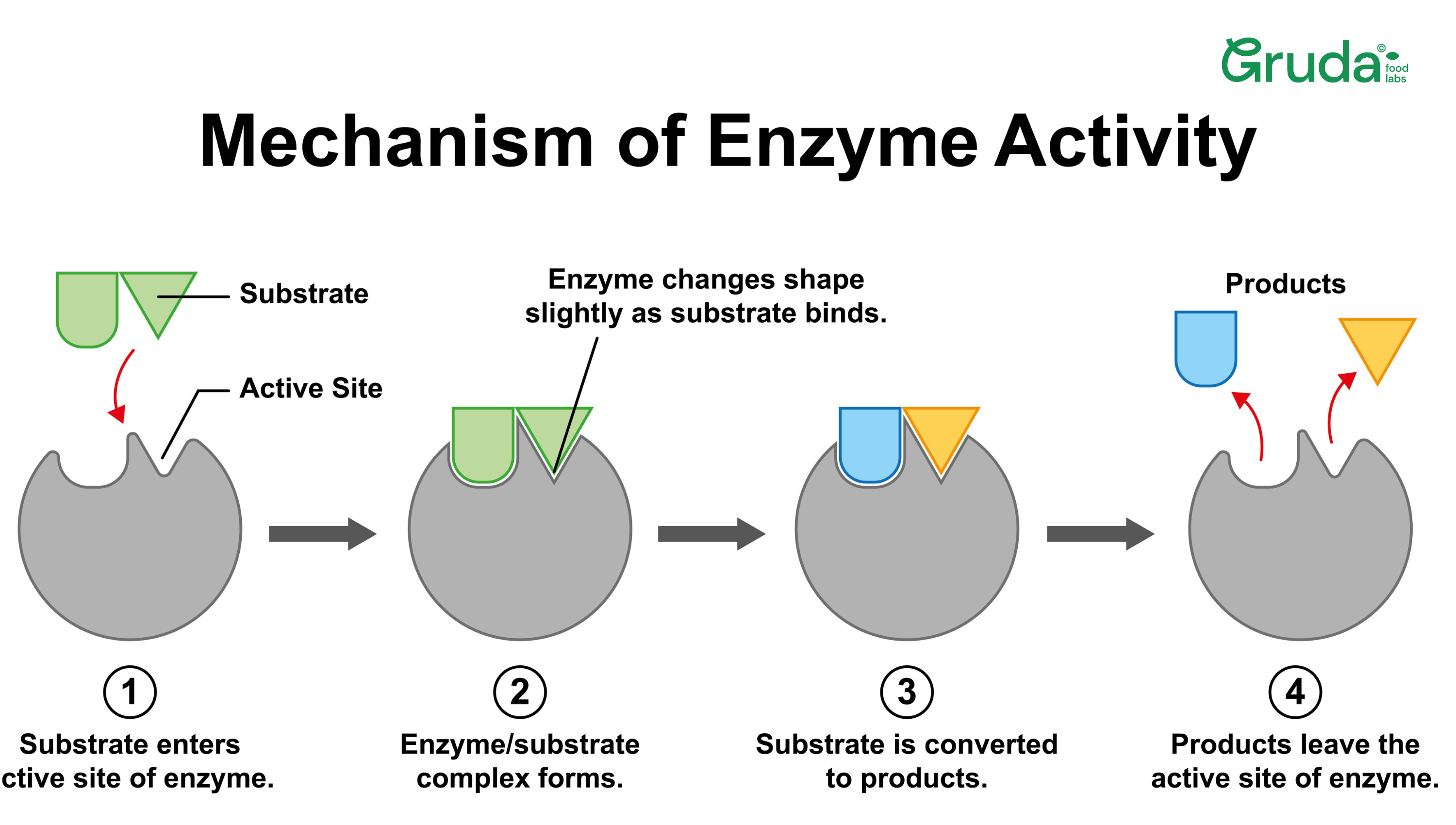
Why Enzymes Are a Critical Tool in Modern Food Product Development
Today’s market demands products that are:
- Lower in sugar
- Lower in additives
- Clean label
- High in nutritional value
Enzymes allow us to achieve these goals without compromising taste.
For example:
- Instead of adding sugar, we break down starch
- Instead of adding stabilizers, we modify protein structures
- Instead of masking off-flavors, we eliminate their source
This makes enzymes a strategic tool in food product development.
Enzymes in Baking, Controlling Dough at a Different Level
In baking, enzymes are almost essential in industrial food product development.
Amylases
One of the most important enzymes in baking.
They break down starch into simple sugars.
Effects:
- Improved fermentation
- Better yeast activity
- Enhanced crust color
- Extended shelf life
Proteases
Break down proteins (gluten).
Effects:
- Dough softening
- Improved processability
- Better adaptation for soft products
Xylanases
Act on hemicellulose fibers in flour.
Effects:
- Increased volume
- Improved crumb structure
- Dough stability
In bakery product development, combining enzymes delivers more precise results compared to relying only on additives.
Enzymes in Functional Beverages, A Real Solution to Off-Flavors
One of the biggest challenges in functional beverage development is off-flavors.
Proteins, vitamins, and minerals often create:
- Bitterness
- Metallic notes
- Lingering aftertaste
This is where enzymes come into play.
Proteases
Can break down proteins and improve:
- Solubility
- Mouthfeel
- Taste
Lactase
Breaks down lactose into simple sugars.
Benefits:
- Natural sweetness
- Lactose-free positioning
- Improved digestibility
Bioactive Enzymes
Used to enhance the bioavailability of functional ingredients.
At Gruda, we use enzymes as part of a deep development process not just as additives, but as tools to solve real formulation challenges.
Enzymes in Juices –Clarity, Stability, and Flavor
In the juice industry, enzymes are a standard.
Pectinases
Break down pectin in fruits.
Results:
- Improved clarity
- Higher yield
- Reduced viscosity
Cellulases
Break down plant cell walls.
Results:
- Release of intracellular compounds
- Improved extraction
Hemicellulases
Enhance the breakdown of complex fibers.
The combination of enzymes enables:
- Higher extraction efficiency
- Smoother texture
- Long-term stability
In food product development, especially natural juices, this is critical.
Enzymes in Dairy –Texture, Flavor, and Digestibility
Dairy is one of the key sectors where enzymes play a central role.
Rennet
Used in cheese production.
Lactase
For lactose-free products.
Lipases
Influence flavor development in cheeses.
Using enzymes allows:
- Creation of diverse textures
- Development of complex flavor profiles
- Nutritional adaptation
Enzymes in Alternative Protein Development
In the world of plant-based and alternative proteins, enzymes are a critical tool for food product development.
They enable:
- Breakdown of plant proteins
- Texture improvement
- Reduction of off-flavors
- Creation of meat-like structures
This is one of the most advanced areas in modern food development.
Enzymes and Shelf Life Improvement
Enzymes can also impact shelf life:
- Prevention of staling
- Improved structural stability
- Reduction of spoilage processes
For example:
Amylases in baking help reduce retrogradation and maintain freshness.
Challenges in Working with Enzymes
Despite their advantages, enzymes require precision:
- Sensitivity to temperature
- Sensitivity to pH
- Accurate dosing
- Controlled reaction time
Even small deviations can significantly impact the final result.
That’s why in food product development, it is essential to work with a team that deeply understands the system.
Enzymes and Clean Label
One of the biggest advantages of enzymes is their compatibility with the clean label trend.
Instead of adding additives:
- The enzyme performs a natural transformation
- Ingredient lists remain cleaner
- Consumer perception improves
Food Product Development with Enzymes at Gruda
At Gruda, enzymes are part of our overall development philosophy.
We combine:
- Chefs
- Food technologists
- Advanced laboratory capabilities
And use enzymes to:
- Solve texture challenges
- Improve taste
- Reduce costs
- Drive real innovation
The process is not only technical, it is creative and strategic.
The Future of Enzymes in the Food Industry
The future is moving toward:
- Tailor-made enzymes
- Integration with AI
- Targeted solutions for specific challenges
- Development of entirely new product categories
Those who know how to work with enzymes will lead the future of food product development.
Enzymes are one of the most powerful tools in modern food product development.
They allow us to work at a deeper, more precise, and more intelligent level.
Whether in baking, functional beverages, juices, or alternative proteins, enzymes are no longer an advantage, but a standard.
At Gruda, we integrate enzymes as a core part of food product development, creating products that truly perform, both in the lab and in the market.
Let’s create something completely new
We believe in the power of collaboration. Let's explore projects, share insights, and work together to expand the boundaries of food.
