Isomalt

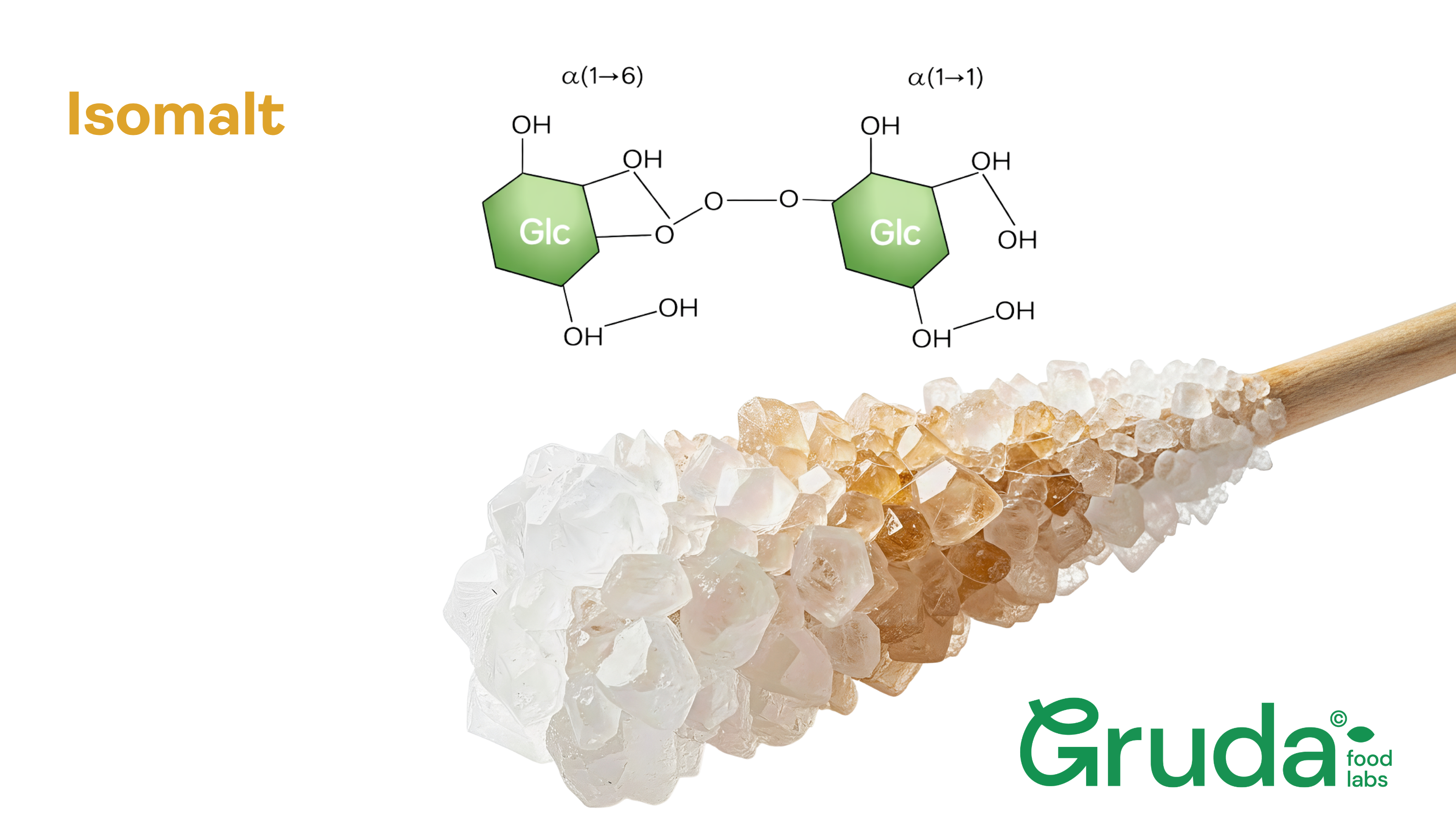
Isomalt is one of the most important polyols in the modern food industry, especially in the field of sugar-free products. It is a sugar alcohol derived from sucrose through a chemical and enzymatic process, serving as a sweetener with lower caloric value than regular sugar.
Its uniqueness lies in providing technological properties very similar to sugar - it creates stable structures, participates in cooking processes, and provides texture and volume. Due to these properties it is particularly common in the confectionery industry, pastry, and sugar-free product development.
In addition to industrial uses, isomalt has also become a popular raw material among chefs and confectioners, especially in sugar sculpting and creating decorative elements in dishes.
In advanced labs like Gruda Food Lab, isomalt is used in developing sugar-free confectionery, functional products, and low-calorie products.
Source and Production Process
Isomalt is produced from sucrose - regular sugar derived from sugarcane or sugar beet. The production process involves two main stages.
In the first stage, an enzymatic process converts sucrose to isomaltulose - an isomer of sucrose in which the bond between glucose and fructose changes.
In the second stage, a hydrogenation process converts isomaltulose to a stable polyol. The result is a mixture of two main isomers, together called isomalt.
Chemical Structure
Isomalt belongs to the polyol family - sugar alcohols formed when sugars undergo a reduction process that changes the carbonyl group to a hydroxyl group.
The human body only partially digests isomalt. Some is absorbed in the small intestine, while the rest reaches the large intestine and undergoes bacterial fermentation. This results in a lower caloric value than regular sugar.
Functional Properties
One of the key advantages of isomalt is its thermal stability. It can withstand relatively high temperatures without breaking down quickly, making it suitable for cooking and baking processes.
Unlike regular sugar, isomalt does not absorb moisture rapidly - making it particularly suitable for products requiring long-term stability.
The sweetness of isomalt is approximately 45 to 65 percent of sucrose intensity, allowing control of the sweetness profile when combined with additional sweeteners.
Applications in the Food Industry
Isomalt is widely used in the confectionery industry for hard candies, toffees, chewing gums, and sugar-free products.
In pastry it is used for caramels and coatings, especially in products for consumers reducing sugar intake.
It can also be found in certain baked goods and low-calorie snacks.
Culinary Applications
Isomalt has become particularly popular among chefs and confectioners because it creates more transparent and stable structures than regular sugar.
When melted and cooled, it can form decorative structures such as transparent domes, plating decorations, or artistic elements.
Unlike regular sugar, structures made from isomalt are less sensitive to moisture and therefore remain stable for longer - making it an important material in modern pastry.
Effects on Mouthfeel
Isomalt provides a pleasant but less intense sweetness than sugar, and creates a slight cooling sensation in the mouth. This cooling effect arises from the endothermic reaction when the material dissolves in saliva.
In certain products this property can be an advantage, especially in chewing gum or candy.
Combinations with Other Sweeteners
Due to its relatively low sweetness, isomalt is commonly combined with intensive sweeteners such as stevia or sucralose to achieve a sweetness profile closer to sugar, while its bulk provides structure and texture.
Technological Advantages
Isomalt offers several important advantages: it is stable at high temperatures, does not absorb moisture quickly, provides physical structure in the product, and does not cause sharp rises in blood sugar levels. Its high chemical stability also allows prolonged storage of products containing it.
Limitations and Challenges
Like other polyols, isomalt may have a laxative effect when consumed in large quantities, often requiring an appropriate warning on the packaging.
Its relatively low sweetness also requires combination with other sweeteners when a high level of sweetness is desired.
Regulation
Isomalt is approved for use in the food industry in many countries. In Europe it is labeled as food additive E953, and is considered safe for use as long as accepted consumption guidelines are met.
Applications in Food Product Development
In modern food product development isomalt is used mainly in sugar-free products, creating stable physical structures in candies, snacks, and baked goods. It is also used in functional products intended to reduce sugar intake.
Summary
Isomalt is a particularly important raw material in the food industry, especially in sugar-free products. It provides high thermal stability, physical structure, and moisture resistance - making it a central ingredient in both the confectionery industry and modern pastry.
Its combination with other sweeteners enables the development of a wide range of products with a customized sweetness profile, while maintaining structure and texture.